Class 6 Additional Algebraic and Number Concepts Practice Quiz
Shiv Kids Education
Excellence in Primary Mathematics
NCERT Mathematics Quiz
NCERT Class 6 Additional Algebraic and Number Concepts Practice Quiz
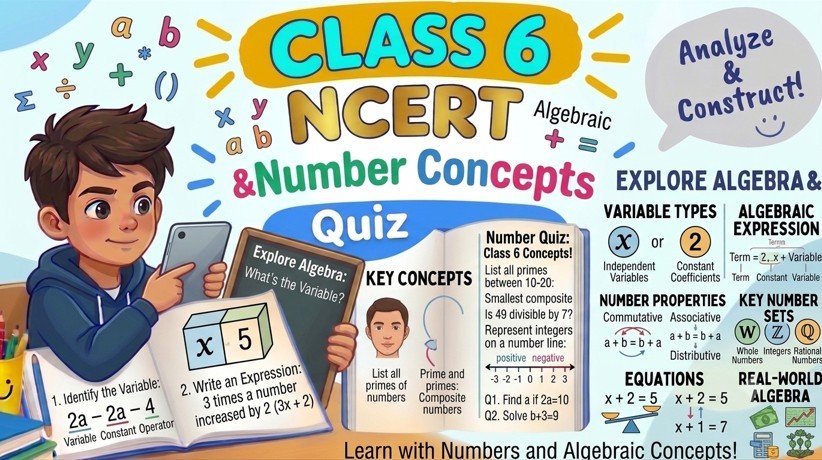
Subject: Mathematics Grade: Class 6 Total Questions: 60
SECTION A: Single Choice MCQs (Questions 1 to 30)
1. What is the algebraic expression for “7 subtracted from twice a number x”?
2. Identify the solution of the equation 3x + 5 = 20.
3. Which of the following is an equation with a variable?
4. If the perimeter of a regular hexagon is given by 6l, what does ‘l’ represent?
5. Express “p is increased by 12” as an algebraic expression.
6. State whether “y + 10 = 25” is an equation with:
7. Find the value of 4x – 3 when x = 5.
8. If a pen costs rupees x and a notebook costs rupees y, what is the total cost of 3 pens and 2 notebooks?
9. Which of the following expressions represents “product of numbers m and n added to 5”?
10. Solve for m: m / 4 = 7.
11. What is the rule for the number of matchsticks required to make a pattern of letter ‘T’ as ‘T, T, T…’ if each ‘T’ uses 2 matchsticks?
12. Which statement translates the equation x – 5 = 12?
13. If Rohan’s present age is y years, what will be his age 5 years from now?
14. Which of the following represents an inequality rather than an equation?
15. If a box contains ‘b’ mangoes and 3 such boxes are packed along with 5 loose mangoes, total mangoes are:
16. What is the root of the equation 2x = 14?
17. Which expression means “half of a number x decreased by 4”?
18. The length of a rectangular hall is 4 meters less than 3 times its breadth. If breadth is b meters, length is:
19. Identify the operation used in the expression 9y.
20. What value of y satisfies y + 9 = 15?
21. A pattern made of matchsticks uses 5 sticks for each geometric shape. For n shapes, total sticks are:
22. Which of these is a numerical expression without any variable?
23. If Sara has ‘k’ stamps, and her brother has 3 times as many plus 4 more, her brother has:
24. Solve the equation: 10 – x = 4.
25. What does an equals sign (=) indicate in an algebraic equation?
26. If a car travels at a speed of v kilometers per hour, how far does it travel in 4 hours?
27. Which of the following is a variable?
28. Find the value of expression 6 – 2t when t = 2.
29. Which mathematical term describes letters used to represent unknown quantities?
30. Express algebraically: “The quotient of x by 3 is added to y”.
SECTION B: Multi-Selection MCQs (Questions 31 to 60 – Select ALL correct)
31. Which of the following expressions represent “10 more than a number y”? Multiple
32. Which of the following are valid algebraic equations? Multiple
33. Select expressions that have a value of 15 when x = 3: Multiple
34. Which statements correctly describe the expression 4p – 3? Multiple
35. Which equations have x = 6 as their solution? Multiple
36. Which of the following are examples of variables? Multiple
37. Select equations where y = 5 is a solution: Multiple
38. Which expressions represent “half of number m”? Multiple
39. Which statements describe numerical expressions? Multiple
40. Select the correct algebraic translations for “Product of 7 and x”: Multiple
41. Which of the following indicate mathematical inequalities? Multiple
42. If a box holds 12 oranges, how do we express total oranges in ‘b’ boxes? Multiple
43. Which of the following represent constants? Multiple
44. Select equations that yield fractions or decimals when solved: Multiple
45. Which of these are algebraic expressions (not equations)? Multiple
46. Which expressions mean “take away 4 from x”? Multiple
47. Select operations that can be performed between variables and constants: Multiple
48. Which expressions evaluate to 20 when evaluated for x = 4? Multiple
49. What components make up an algebraic equation? Multiple
50. Which expressions denote “triple of a number added to 5”? Multiple
51. Select the equations that have x = 10 as a solution: Multiple
52. Which of the following rules represent the perimeter of a square with side length s? Multiple
53. Which statements are true regarding variables? Multiple
54. Which algebraic expressions mean “y divided by 4”? Multiple
55. Select the expressions that equal 12 when p = 2: Multiple
56. Which equations give x = 8 when solved? Multiple
57. Which choices describe mathematical operations used in algebra? Multiple
58. Select options that are correct statements regarding expressions and equations: Multiple
59. Which of the following can be represented using variables in real life? Multiple
60. Which expressions represent “subtracted 7 from product of 5 and y”? Multiple
Quiz Performance Summary
Mastering Class 6 Mathematics: Additional Algebraic and Number Concepts
Welcome to the comprehensive guide on NCERT Class 6 Mathematics Chapter 9, focusing on additional algebraic and number concepts. As students transition from primary arithmetic to middle-school mathematics, algebra introduces a powerful shift in perspective. Instead of working exclusively with fixed numbers, learners begin exploring unknowns, generalized arithmetic rules, and mathematical relationships through symbols and letters. This transition builds foundational abstract thinking skills critical for success in higher mathematics, engineering, science, and computer programming.
Free Download NCERT Class 6 Additional Algebraic and Number Concepts quiz Worksheet – 50 Most Important questions with answers

Understanding Variables and Constants
At the heart of algebra are two core components: constants and variables. A constant is a fixed numerical value that never changes, such as the numbers 5, -12, or 3.14. Conversely, a variable is a symbol—typically represented by letters like x, y, m, n, or p—that can take on various numerical values. Variables act as placeholders or empty containers for unknown quantities. For example, if you save an unknown amount of money each month, you can represent that amount with the variable m. As your savings grow or change across months, the variable allows you to generalize your financial calculations without rewriting equations from scratch.
From Arithmetic Rules to Algebraic Expressions
Arithmetic deals with specific calculations like adding 4 and 5 to get 9. Algebra generalizes these operations into expressions. An algebraic expression is a combination of constants, variables, and operational symbols (+, -, *, /) joined together. For instance, if a problem states “5 more than a number x,” it translates directly into the algebraic expression x + 5. Learning how to translate everyday verbal statements into precise mathematical expressions is one of the most vital milestones for Class 6 students. It teaches children how to break down complex word problems into clear, manageable mathematical components.
Formulating Rules and Patterns with Matchsticks
One of the most engaging ways NCERT introduces algebra is through pattern recognition using matchsticks. When students build geometric shapes—such as triangles, squares, or letters like L, T, and H—they notice regular growth patterns. If making one letter T requires 2 matchsticks, making 2 letters requires 4 sticks, and making n letters requires 2n sticks. This simple exercise demonstrates how variables describe generalized rules, allowing us to predict outcomes for any large number n without having to count physical sticks individually.
The Distinction Between Expressions and Equations
Students often confuse expressions with equations, but understanding the boundary between them is crucial. An algebraic expression is a mathematical phrase that does not contain an equals sign (=). Examples include 3x + 2 or y – 7; these simplify or evaluate to different values depending on what number is substituted for the variable. On the other hand, an equation is a statement that two algebraic expressions are equal, marked explicitly by an equals sign, such as 3x + 2 = 11. An equation poses a puzzle: “For what specific value of the variable does this statement hold true?” Finding that value is called solving the equation, and the resulting value is known as the root or solution.
Solving Simple Linear Equations
Class 6 students learn how to solve basic linear equations using logical reasoning and balancing techniques. Consider the equation x + 4 = 10. To find the unknown value of x, students determine what number when added to 4 results in 10, or they subtract 4 from both sides to isolate the variable, yielding x = 6. This balance method ensures that whatever operation is performed on one side of an equation must also be performed on the other, maintaining equilibrium just like a physical weighing scale.
Real-World Applications of Algebraic Concepts
Algebra is not merely an abstract classroom subject; it governs everyday logic and problem-solving. Whether calculating travel distance given speed and time, computing total costs for bulk market items, managing personal budgets, or scaling recipes in cooking, algebraic formulas streamline calculations. When children master these concepts early, they develop strong analytical reasoning, structured problem-solving habits, and greater confidence in tackling numerical challenges.
Why Interactive Quizzes Enhance Learning
Interactive digital worksheets offer powerful pedagogical advantages over traditional static textbooks:
1. Instant Feedback: Immediate visual indicators confirm correct answers or highlight mistakes instantly, fostering a constructive trial-and-error learning environment.
2. Multi-Selection Assessment: Requiring students to identify multiple correct choices per question encourages thorough critical evaluation rather than simple guessing, deepening conceptual retention.
3. Structured Progression: A balanced mix of single-choice and multi-selection problems ensures that students thoroughly review every nuance of algebraic principles, building robust mastery over the curriculum.