NCERT Class 3 Maths – 2D Shapes and Problem-Solving
Shiv Kids Education
Excellence in Primary Mathematics
NCERT Mathematics Quiz
NCERT Class 3 Maths – 2D Shapes and Problem-Solving
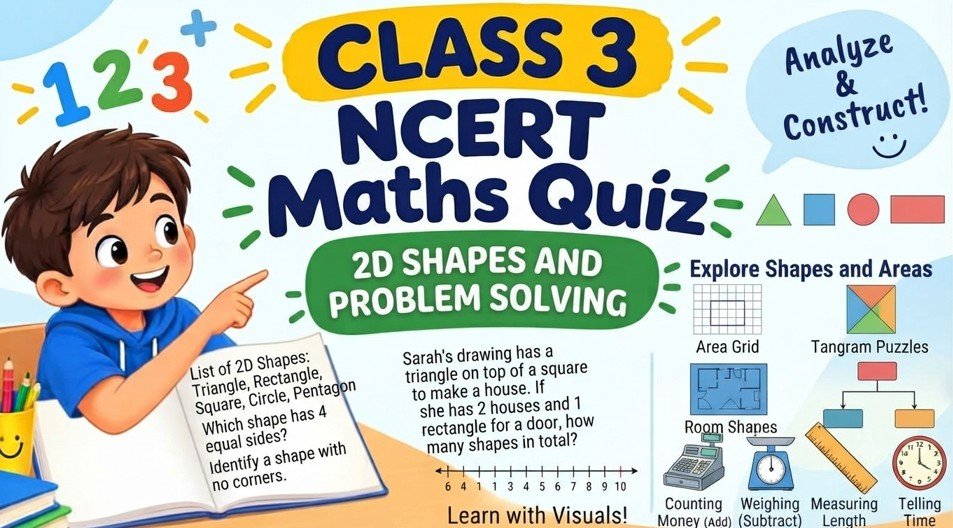
Subject: Mathematics Grade: Primary Class 3 Total Questions: 30
SECTION A: Single Choice MCQs (Questions 1 to 15)
1. Which 2D shape has 3 straight sides and 3 corners?
2. How many corners does a rectangle have?
3. Which geometric shape has all four sides of equal length and 4 right angles?
4. Which of the following shapes has no corners and no straight edges?
5. What is the special feature of a rectangle’s opposite sides?
6. A carrom board has a shape similar to which 2D geometric figure?
7. Rahul has a post card in his hand. What shape does it look like?
8. How many total straight lines are needed to draw 2 separate triangles?
9. If you join 2 identical squares side by side, what shape do you roughly form?
10. What is the sum of the number of corners in a square and a triangle?
11. A bangle or a coin represents which type of 2D boundary line?
12. Priya wants to trace the base of a glass bottle. What shape will she get on paper?
13. How many total corners are there in 3 squares combined?
14. Which shape can be formed using 4 matchsticks of equal length?
15. What do we call a closed 2D shape bounded by 5 straight sides?
SECTION B: Multi-Selection MCQs (Questions 16 to 30 – Select ALL correct)
16. Which 2D shapes have 4 straight sides? Multiple
17. Which objects typically have a circular shape? Multiple
18. Which of these shapes have corners? Multiple
19. Which statements are TRUE about a square? Multiple
20. Which real-life items look like a rectangle? Multiple
21. Problem-solving: If a park has 4 straight boundary walls of equal size forming a closed shape, what can its shape be? Multiple
22. Which shapes can be drawn using only straight lines? Multiple
23. Which shapes have curved boundaries? Multiple
24. Problem-solving: Amit has 12 matchsticks. Which shapes can he make using all 12 matchsticks equally per shape (assuming 1 matchstick per side)? Multiple
25. Which geometric figures have exactly 4 sides and 4 corners? Multiple
26. Which properties apply to a triangle? Multiple
27. Problem-solving: If you cut a square piece of paper diagonally from one corner to the opposite corner, what new shapes are created? Multiple
28. Which of the following features are common to both squares and rectangles? Multiple
29. Which options represent basic 2D geometric shapes taught in primary school? Multiple
30. Problem-solving: What can be counted to distinguish different 2D flat shapes from one another? Multiple
Quiz Performance Summary
Mastering Class 3 Maths: Exploring 2D Shapes and Basic Problem-Solving
Geometry is one of the most engaging and visually intuitive branches of mathematics for primary school children. For NCERT Class 3 students, stepping into the world of two-dimensional (2D) shapes opens up a practical framework for understanding the physical environment. Flat shapes such as squares, rectangles, triangles, and circles form the fundamental building blocks of spatial awareness, architectural design, engineering, and everyday art. By identifying how these figures are constructed, young learners transition from casual observation to structured analytical thinking.
Free Download NCERT Class 3 Maths Worksheet – 2D shapes and basic problem-solving – 50 Most Important questions

Understanding the Core Characteristics of 2D Shapes
Two-dimensional shapes are flat figures that possess only two dimensions: length and width. Unlike 3D objects, they do not have thickness or height. To master Class 3 geometry, students learn to classify shapes by examining specific attributes:
1. Sides and Edges: A side is a straight or curved line segment that forms the boundary of a shape. For example, a triangle has three straight sides, whereas a circle is bounded by a single continuous curved line. Recognizing whether an edge is straight or curved helps children differentiate shapes quickly.
2. Corners (Vertices): Corners occur where two sides meet. Squares and rectangles have four corners, triangles have three corners, and circles have zero corners. Counting corners is a foolproof method for primary students to verify shape categories.
Detailed Breakdown of Essential 2D Figures
The Square: A square is a regular geometric quadrilateral characterized by four equal straight sides and four right-angle corners. Everyday items like chessboards, handkerchiefs, and tiles provide concrete examples that help children visualize symmetry and equal length.
The Rectangle: Like the square, a rectangle has four straight sides and four corners. However, its defining property is that only its opposite sides are equal in length. Doors, windows, blackboards, and books serve as ideal real-life models for rectangular shapes.
The Triangle: Triangles are unique three-sided polygons with three corners. They are known for their structural stability and appear frequently in bridges, roofs, musical instruments like triangles, and slice patterns.
The Circle: Circles are perfectly round 2D curves where every point on the boundary is equidistant from the center. Coins, bangles, wheels, and buttons offer tangible circular references for children.
Practical Problem-Solving in Geometry
Geometry in Class 3 goes beyond rote memorization; it emphasizes active problem-solving. Children encounter puzzles involving matchsticks, tangrams, paper folding, and grid tracing. For instance, determining how many matchsticks are needed to build multiple triangles or discovering what shapes emerge when a square paper is cut diagonally nurtures critical reasoning. Logical deduction tasks—such as finding combined corner counts or identifying shapes based on clues about side lengths—build robust mathematical stamina.
Why Interactive Digital Assessments Drive Superior Learning Outcomes
Integrating interactive online quizzes with traditional study methods provides distinct advantages for young learners:
1. Immediate Reinforcement: Instant feedback lets students know immediately whether their choice is correct or incorrect, encouraging mindful reflection rather than random guessing.
2. Enhanced Critical Thinking via Multi-Selection Questions: Multi-select assessment items challenge students to evaluate every single option thoroughly, verifying all correct properties before submitting their answers.
3. Self-Paced Engagement: A clean layout, clear typography, and structured sections eliminate visual clutter, allowing students to focus entirely on mathematical problem-solving.