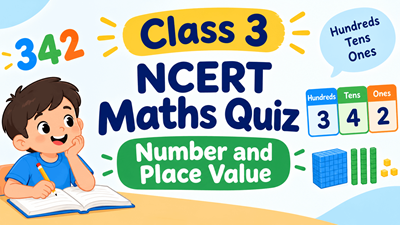
Class 3 NCERT Maths Quiz
Shiv Kids Education
Excellence in Primary Mathematics
Class 3 NCERT Maths Quiz
Numbers & Place Value Practice (Up to 1000)
Subject: Mathematics Grade: Primary Class 3 Total Questions: 12
SECTION A: Single Choice MCQs (Questions 1 to 6)
1. What is the number name for 709?
2. Which number is 10 more than 590?
3. What is the place value of digit ‘8’ in 835?
4. Identify the missing number in the pattern:
310, 330, 350, [ ? ], 390
5. What is the predecessor of the smallest 3-digit number?
6. Total blocks represented below:
[100] [100] [100] + [10] [10] [10] [10] + [1]
SECTION B: Multi-Selection MCQs (Questions 7 to 12 – Select ALL correct)
7. Which representations equal 650? Multiple
8. Select all numbers smaller than 800: Multiple
9. Which are TRUE for the number 924? Multiple
10. Choose numbers with ‘7’ in Hundreds place: Multiple
11. Which pairs show skip counting by 50s? Multiple
12. Select three-digit EVEN numbers: Multiple
Quiz Performance Summary
Mastering Class 3 NCERT Maths Quiz: Place Value, Numbers up to 1000, and Interactive Learning
Mathematics forms the cornerstone of logical thinking and analytical reasoning for young learners. In primary education, particularly within the NCERT Class 3 Maths curriculum, understanding numbers up to 1000 and the fundamental principles of place value serves as a vital bridge between basic counting and advanced arithmetical operations. When students grasp how individual digits function according to their position within a three-digit number, they unlock the ability to solve addition, subtraction, estimation, and word problems with confidence.
Download Class 3 NCERT Maths Quiz Worksheet – Numbers & Place Value up to 1000 – 50 Most Important questions

Understanding Place Value and Face Value in 3-Digit Numbers
To master numbers up to 1000, students must first distinguish between place value and face value. The face value of a digit represents its intrinsic worth regardless of position—for instance, the face value of the digit ‘7’ in 742 is simply 7. However, place value represents the numerical value a digit holds based on its position in a number. In a typical three-digit number, the positions are categorized into Hundreds (H), Tens (T), and Ones (O). In 742, the digit ‘7’ occupies the Hundreds position, giving it a place value of 700. The digit ‘4’ sits in the Tens position with a value of 40, and ‘2’ occupies the Ones position with a value of 2.
Teaching children to decompose numbers into expanded form—such as $700 + 40 + 2 = 742$—solidifies their structural understanding of arithmetic. It also helps young learners visualize quantities using concrete models like base-ten blocks, abacus beads, and visual grouping exercises. Understanding that 10 Ones form 1 Ten, and 10 Tens combine to form 1 Hundred, establishes intuitive mental mathematical models that benefit students throughout their academic journey.
Skip Counting, Predecessors, and Successors
Beyond static place value identification, primary mathematics emphasizes dynamic number patterns. Concepts like skip counting by 10s, 50s, and 100s help children develop number sense and prepare them for multiplication tables. Identifying the successor (the number directly following a given value, found by adding 1) and the predecessor (the number directly preceding a given value, found by subtracting 1) encourages fluid navigation along the number line.
For instance, understanding that the predecessor of the smallest three-digit number (100) is the largest two-digit number (99) allows students to recognize structural boundaries within the base-ten decimal system. Similarly, learning to quickly spot even numbers (ending in 0, 2, 4, 6, or 8) versus odd numbers (ending in 1, 3, 5, 7, or 9) enhances conceptual fluency.
Why Interactive Practice Quizzes Boost Student Engagement
Traditional paper worksheets are excellent for handwriting practice and formal assessment, but interactive digital quizzes powered by JavaScript and jQuery offer distinct pedagogical advantages for modern elementary education:
1. Immediate Feedback Loop: Traditional learning methods require waiting for teacher grading, which can delay error correction. Interactive quizzes provide instantaneous feedback. When students pick an answer and immediately see a visual indicator (like a green card for correct or red for incorrect), their brain instantly reinforces correct pathways or prompts immediate reflection on miscalculations.
2. Multi-Format Questions: Combining traditional single-choice multiple-choice questions (MCQs) with multi-selection MCQs challenges higher-order thinking skills. Multi-select questions require students to evaluate every single option independently rather than guessing by process of elimination, ensuring deep understanding of equivalent expressions like $650 = 600 + 50 = 65 \text{ Tens}$.
3. Enhanced Visual Ergonomics: Legibility is critical for primary students. By utilizing enlarged font sizes (14px–16px text), clear line spacing, and soft color transitions, digital learning platforms minimize eye strain and keep young learners focused on reasoning rather than struggling to read tiny text.
4. Positive Reinforcement and Motivation: Closing practice sessions with performance summaries and inspiring motivational quotes builds resilience and a growth mindset. Encouraging statements remind young mathematicians that mistakes are simply stepping stones toward mastery, making daily practice an enjoyable experience.